


Discreet Comfort
Seamless integration into homes and offices.

Year-Round Control
Ideal for Adelaide's climate.

Multiple Rooms
A network of ducts servicing multiple rooms.

Zoning
Personalised control in different areas, promoting energy efficiency and cost savings

Expert Guidance and Custom Solutions
Professional advice ensures perfectly sized systems for an efficient home climate.

Sleek and Discreet Design
Efficient climate control without compromising aesthetics.

Energy-Efficient
Modern inverter drive, AC units coupled with a zoning system to reduce operational costs.









We strongly recommend leaving this to the experts at Joe Cools. Choosing the correct size and output is essential to ensure your air conditioning system performs efficiently and meets your comfort needs. An undersized or oversized unit can lead to reduced efficiency, higher energy costs, and compromised performance.
Several factors influence the ideal unit selection, including:
- The size and layout of the area to be conditioned
- Ceiling height
- Building construction materials (e.g., brick, weatherboard, timber, bluestone, galvanised iron)
- Roof type and structure
- Level of insulation
- Space available for housing the indoor unit
- Occupancy rate
- Heat load from appliances or equipment (e.g., ovens, computers, lighting)
- Orientation of the building and windows
- Shading and exposure of windows
- Local climate and temperature fluctuations
- Ventilation and air circulation
Our team will carefully assess these factors to recommend the most efficient and effective solution for your home.
Flexible ductwork is used to manage airflow in heating, cooling, and ventilation systems. At Joe Cools, ductwork is custom designed for each project, tailored to the specific areas the client wishes to air condition. This system is often referred to as a ducted system (see illustration).

A ducted system regulates the flow of air into and out of the building through supply air, return air, and exhaust air pathways, ensuring optimal temperature and air quality.
Experienced air conditioning installers at Joe Cools carefully plan the layout, size, and placement of ductwork. They also account for pressure losses within the system to ensure the best possible indoor air quality, thermal comfort, and airflow efficiency. Every element is designed to create a well balanced and efficient climate control solution.

Air conditioning diffusers come in various shapes, including square, round, rectangular, and curved. A Linear Slot Diffuser (LSD) is a modern choice that features a long, narrow rectangular slot or grille, typically semi-concealed in a fixed or suspended ceiling. Linear Slot Grilles can be single or multi-slot configurations and are available in finishes such as white and anodized silver.
To see how a Linear Slot Diffuser directs airflow, check out this demonstration video: Linear Slot Smoke Test / Air Con. The video visually illustrates the precise directional flow of air emerging from both the short and long ends of the slot.

To see how a Linear Slot Diffuser directs airflow, check out this demonstration video: Linear Slot Smoke Test / Air Con. The video visually illustrates the precise directional flow of air emerging from both the short and long ends of the slot.
Joe Cools recommends installing the outdoor unit on a stable platform such as a concrete slab, brackets, mounting blocks, or a roof mount kit. These options help minimise vibration and noise, and by keeping the unit elevated, you also reduce the likelihood of pests, such as bugs and slugs, from nesting underneath and potentially causing electrical issues or damage. Proper placement ensures optimal performance and longevity of your air conditioning system.
While it’s understandable to want to hide your outdoor unit, it’s important to ensure there is adequate clearance around, on top, and in front of the unit for proper operation. Covers or enclosures can sometimes restrict airflow, which may reduce the system’s efficiency and effectiveness. For optimal performance, any disguise should allow for sufficient ventilation and access.
Most homes are typically supplied with single-phase 240 volts. Air conditioning units up to about 16 kilowatts, and sometimes up to 18 kilowatts, generally use this single-phase supply. Larger units exceeding 16 kilowatts typically require a three-phase 415-volt supply.
Three-phase air conditioners are commonly used for larger areas needing higher heating or cooling capacity. If your installation requires a three-phase unit, it’s important to arrange for a three-phase supply in advance of the installation day. Joe Cools can help determine whether you need a single-phase or three-phase supply based on your specific requirements.
3-phase electrical power is a type of power supply used mainly for large equipment and machines. It involves three separate currents that work together to provide a steady and efficient flow of electricity. This system uses three wires carrying these currents and one wire for neutral. It’s more efficient for heavy-duty tasks compared to single-phase power, which is what most homes use and has just two wires: one for power and one for neutral.
Single-phase electrical power is the standard type of electricity used in most homes. It uses two wires: one for power and one for neutral. This setup provides enough electricity to run everyday appliances like lights, TVs, and most air conditioners.
Multidirectional outlet diffusers allow you to adjust the air direction and flow of the air.


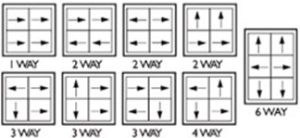
The ceiling outlet is comprised of 4-6 smaller squares called ‘cores’. There are 2 main types of cores – fixed and adjustable.
- An adjustable core allows the user to direct airflow by turning the blades a particular way to direct airflow in that direction.
- A fixed core only allows for the cores themselves to be rotated to gain direct airflow. To adjust the outlet, simply push up on each of the four segments one at a time and rotate each of them in desired direction for airflow.
- Ducted disposable filters: Replace every 3-6 months, or up to 9-12 months depending on system usage.
- Ducted reusable filters: Replace every 1-2 years.
- Wall split system filters: These should last the lifetime of the unit if properly maintained with regular cleaning.


To test if each zone is fully opening and closing, follow these steps:
- Turn off all zones except one.
- Set the AC unit to fan mode for continuous airflow.
- Listen for airflow from the vent in the active zone (e.g., zone 1) to ensure it’s fully open.
- Turn on zone 2 and then turn off zone 1 to verify that zone 1 fully closes and zone 2 opens.
- Repeat this process for all zones, testing one at a time.
- If you can’t hear the airflow, attach a tissue to the end of a broomstick and hold it near the ceiling vent. The tissue’s movement will indicate whether air is flowing through the vent.
Here’s a quick and easy way to clean your air conditioning vents:
- Plastic vents: Many plastic vents can be cleaned by placing them on the top rack of your dishwasher. Use a gentle, low temperature setting.
- Hand wash: If you prefer, you can also wash the vents manually using warm, soapy water. Soak and gently scrub them.
- Vacuum: For a quick clean, use the brush head attachment of a vacuum cleaner to remove dust and debris from the vents.
- Microfibre cloth: After vacuuming, gently wipe down the vents with a microfibre cloth to remove any remaining dirt or dust.
Be sure to dry vents thoroughly before reinstalling.
- Check the air conditioner’s filters are clean. Air Con Filter Maintenance Ducted, Air Con Filter Maintenance Wall Split.
- Check the indoor air handler (ceiling unit) is free of obstructions.
- Check there aren’t any leaks in the ductwork.
- Is the fan motor running?
- Is the return air grille obstructed?
If the system has motorised zone motor control, check that they are operating correctly (see our ‘How do I know if all my AC zone motors are operating?’ FAQ).