


Natural Cooling
Embrace eco-friendly cooling by utilising air and water with evaporative air conditioning.

Open Space Comfort
Ideal for expansive areas like patios and workshops.

Low Humidity Efficiency
Thrives in dry climates, ensuring effective cooling performance.

Cost Effective Operation
Consumes less electricity as primarily relies on the evaporation process.

Expertise in Open Space Cooling
Trusted advisors for cooling expansive spaces with energy-efficient evaporative solutions.

Low-Humidity Mastery
Experience optimal cooling in dry climates tailored for efficient performance.

Fresh Air Flow
Increase the flow of fresh air indoors by utilising Evaporative Air Conditioning and natural cooling.


According to the National Asthma Council (2016), “Higher levels of humidity in the home create an environment for two common asthma and allergy triggers: dust mites and mould” Source: National Asthma Council.
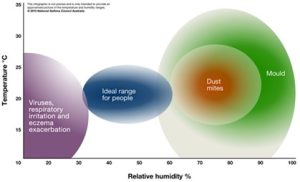
Figure: Approximation of optimal temperature and humidity ranges for individuals with respiratory conditions.
For people with asthma or allergies, managing indoor humidity is crucial. The National Asthma Council suggests that refrigerative air conditioning systems are a better choice for controlling humidity, as they actively reduce moisture levels. Additionally, refrigerative systems help filter out fine dust, pollen, and other airborne particles, providing a cleaner and healthier indoor environment.
- Humidity Impact: Evaporative air conditioners work best on dry, hot days. They are less effective when it’s both hot and humid. Relative humidity significantly affects cooling efficiency. When humidity is at 100%, the air is fully saturated with moisture, making it harder for additional moisture to evaporate. Since evaporative coolers rely on this evaporation process to cool the air, they perform poorly in high humidity. On muggy days, they mainly provide increased air movement rather than significant cooling.
- Humidity Levels: Evaporative coolers are effective when outdoor relative humidity is below 30%. They are reasonably effective between 30-50% humidity. When humidity exceeds 50%, a refrigerative air conditioner is generally more suitable. Relative humidity is determined by comparing the temperatures of two thermometers: one exposed to air (dry bulb) and one with a wet wick (wet bulb).
- Cooling Potential: The effectiveness of evaporative cooling depends on the difference between the dry-bulb and wet-bulb temperatures. At 100% relative humidity, the wet-bulb temperature equals the dry-bulb temperature, limiting the cooling potential. Evaporative systems are most effective with a wet-bulb temperature up to 22°C and can be used in more humid areas up to 24-25°C. However, higher humidity levels will increase discomfort despite the cooling effect.
- Insufficient Ventilation: Evaporative air conditioners need windows and doors to be open to function properly. This allows the hot, humid air to escape outside and helps the system cool the indoor space effectively.
- High Humidity: When the relative humidity is high, the efficiency of an evaporative air conditioner is significantly reduced. The system relies on evaporating water to cool the air, and high humidity makes this process less effective.