
Lead times for a Joe Cools installation typically range from 1 to 2 weeks after the acceptance of your quotation, with the possibility of even earlier scheduling. We recommend booking in advance to secure priority, particularly for new homes. During peak summer months, demand can be higher, so planning ahead helps minimise wait times and ensures a smooth installation process.
We strongly recommend leaving this to the experts at Joe Cools. Choosing the correct size and output is essential to ensure your air conditioning system performs efficiently and meets your comfort needs. An undersized or oversized unit can lead to reduced efficiency, higher energy costs, and compromised performance.
Several factors influence the ideal unit selection, including:
- The size and layout of the area to be conditioned
- Ceiling height
- Building construction materials (e.g., brick, weatherboard, timber, bluestone, galvanized iron)
- Roof type and structure
- Level of insulation
- Space available for housing the indoor unit
- Occupancy rate
- Heat load from appliances or equipment (e.g., ovens, computers, lighting)
- Orientation of the building and windows
- Shading and exposure of windows
- Local climate and temperature fluctuations
- Ventilation and air circulation
Our team will carefully assess these factors to recommend the most efficient and effective solution for your home.
The Australian Refrigeration Council (ARC) tick is a mark of authorisation for businesses or individuals qualified to install, service, and repair air conditioners. It ensures that they have the necessary training, qualifications, equipment and knowledge to handle these systems safely and legally. Without the ARC tick, a business may be operating illegally and without proper certification.
Always ask to see the technician’s licence before they begin any work. Only licensed professionals are trained to safely handle refrigerants, which can be harmful to the environment if not managed properly. Learn more or check a licence at lookforthetick.com.au.

- You can easily check energy ratings for air conditioners at energyrating.gov.au, but many other factors can influence your energy consumption.
- Energy usage is influenced by a variety of factors such as system design, equipment, and how the unit was installed. The frequency of usage and the efficiency of operation and maintenance also play a significant role. It’s important to note that even a unit with a high star rating can consume more energy if these factors are not optimised.
- To monitor energy use, you can purchase energy-saving meters from sites like amazon.com.au
- Some meters may require installation by a licensed electrician, but they can accurately track your air conditioner’s power consumption and help estimate electricity costs.
- Certain air conditioning units also have built-in functions to display energy consumption, helping you manage usage more efficiently.
MEPS refers to Minimum Energy Performance Standards, an Australian Government regulation that requires all Air Conditioners imported into Australia to meet a minimum level of energy efficiency.
Horsepower (hp) is a measure of mechanical power, traditionally used to describe engine power in the imperial system. It originated when air conditioner compressors were driven by mechanical motors. However, horsepower doesn’t directly measure cooling or heating capacity, which is why using it to describe air conditioners would be misleading.
In Australia, we use the metric system, and kilowatts (kW) are the standard unit for measuring cooling and heating capacity. Kilowatts provide a more accurate representation of the overall performance of an air conditioning unit.
All single-phase, non-ducted air conditioners are required to have an energy label. The Energy Star Rating system helps consumers compare the efficiency of different units— the higher the rating, the more energy-efficient the air conditioner.
It’s important to remember that regardless of the energy rating, smart usage of your air conditioner, coupled with proper installation, can help lower your running costs over time. For more information, refer to energy efficiency ratings and guidelines.
The distinction between comfort and industrial air conditioning can sometimes be blurred
Comfort air conditioning focuses on creating a comfortable indoor environment for people by maintaining optimal temperature and humidity levels. It also considers factors like architectural design, energy efficiency, noise levels, and specialised zoning. Comfort air conditioning systems are commonly used in homes, apartments, offices, schools, shops, theatres, and stadiums—spaces designed primarily for human comfort.
On the other hand, industrial or process air conditioning systems are designed for environmental control in specific processes where precise temperature, humidity, and sometimes filtration are crucial. These systems ensure proper conditions for equipment, machinery, or materials that require exact environmental settings. Examples include cool rooms, laboratories, computer server rooms, wine cellars, libraries, museums, and food or beverage processing facilities. These systems are essential for maintaining the integrity of processes and materials, rather than human comfort.
Installing an air conditioner requires specialised training and expertise. Technicians must be qualified to handle refrigerants and possess the necessary skills for proper installation. At Joe Cools, our team includes A-Class Electricians and Refrigeration Mechanics who meet all Australian Refrigeration Council (ARC) licensing requirements. This ensures that your air conditioning system is installed safely and efficiently by professionals with the right credentials and training.
We have some excellent TIPS for a SMOOTH AC INSTALLATION that will help you prepare for the day.
We understand that your schedule can be busy, and you may not be available for the entire duration of your air conditioning installation. At Joe Cools, we strive to make the process as convenient as possible. While it’s helpful for you to be present, it’s not always necessary. To assist you, we provide a “Tips for a Smooth Installation” information sheet, which guides you on how to prepare for the installation day and ensures everything goes smoothly even if you can’t be there.
Most homes are typically supplied with single-phase 240 volts. Air conditioning units up to about 16 kilowatts, and sometimes up to 18 kilowatts, generally use this single-phase supply. Larger units exceeding 16 kilowatts typically require a three-phase 415-volt supply.
Three-phase air conditioners are commonly used for larger areas needing higher heating or cooling capacity. If your installation requires a three-phase unit, it’s important to arrange for a three-phase supply in advance of the installation day. Joe Cools can help determine whether you need a single-phase or three-phase supply based on your specific requirements.
3-phase electrical power is a type of power supply used mainly for large equipment and machines. It involves three separate currents that work together to provide a steady and efficient flow of electricity. This system uses three wires carrying these currents and one wire for neutral. It’s more efficient for heavy-duty tasks compared to single-phase power, which is what most homes use and has just two wires: one for power and one for neutral.
Single-phase electrical power is the standard type of electricity used in most homes. It uses two wires: one for power and one for neutral. This setup provides enough electricity to run everyday appliances like lights, TVs, and most air conditioners.
- Turn it off when not needed: While air conditioning provides comfort, taking steps to minimize usage can help reduce costs.
- Keep filters clean: Regularly check and clean your air conditioner’s filters to maintain efficiency.
- Pre-cool your space: On very hot days, start your air conditioner early to avoid overworking it. Utilize the timer function to set pre-cooling times.
- Adjust your thermostat: Setting your thermostat 1-2°C higher in cooling mode or 1-2°C lower in heating mode can significantly cut energy use. For instance, setting your AC to 25°C instead of 23°C on a 38°C day can save 20-30% on running costs (Independent Pricing and Regulatory Tribunal, 2016).
- Cool/heat only the rooms you use: Close doors to unused rooms, adjust zoning settings on ducted systems, and use fan-only mode for additional cooling.
- Dress appropriately: Wear light clothing in summer and warm layers in winter to reduce the need for extreme temperature settings.
- Enhance your home’s energy efficiency: Improve ceiling and wall insulation, and draught-proof windows and doors.
- Use window treatments: Close curtains or blinds, apply window tints, and use double-glazing or shutters to help control indoor temperatures and reduce costs.
If your air conditioner was supplied by us, please contact Joe Cools directly for assistance.
For units not supplied by us, follow these steps:
- Locate the Model Number: Check the wall controller or the outdoor unit for a label with the model number. This information is usually found on the side or rear of the unit.
- Search Online: Once you have the model number, Google your air conditioner’s brand and model number. You should be able to find the manual on the manufacturer’s website or other online resources.
These steps should help you obtain a replacement manual.
Comfort levels can vary from person to person, but there are some general guidelines that can help you find a balance between comfort and efficiency:
- For Winter: The National Occupational Health and Safety Commission suggests a temperature range of 20-24°C if you’re wearing heavier clothing.
- For Summer: A comfortable range is 23-26°C if you’re dressed in lighter clothing.
The Australian Standard AS 1837 Code of Practice for Ergonomics recommends a temperature range of 21-24°C for optimal comfort in both factory and office settings.
Ultimately, the best temperature setting is one that suits your personal comfort while allowing your system to operate efficiently.
When you first switch your air conditioner to heating mode, it typically takes about 4-10 minutes to start delivering warm air. This delay occurs because the system undergoes a ‘pre-heat cycle,’ where it needs to warm up the indoor coil before it begins circulating heated air. This process ensures that the air coming from your vents is genuinely warm rather than just room temperature.
Most air conditioners have a built-in time delay, which means they typically take around 4-10 minutes to start up. This delay helps protect the system and ensures it operates efficiently.
If your air conditioner isn’t heating, it might be in defrost mode. This happens because heat pumps can develop frost on the outdoor unit when they’re running in heat mode. When the outdoor coil temperature drops below the dew point, moisture can freeze on the heat exchanger, especially in very cold conditions.
To prevent the unit from freezing up completely, the air conditioner has a built-in defrost system that kicks in automatically. This defrost cycle can take up to 20 minutes. There’s nothing wrong with your system; it’s just working to ensure optimal performance. Once the defrost cycle is complete, your air conditioner should resume heating normally.
On humid days, especially when the relative humidity is at 100%, the temperature feels hotter than the actual reading because sweat does not evaporate effectively. This is known as the ‘Feels Like Temperature.’ High humidity prevents the evaporation of sweat, which is our body’s way of cooling down, making us feel much warmer than the measured temperature. Conversely, on days with low humidity, sweat evaporates quickly, making us feel cooler than the actual temperature, but it can also make the air feel very dry.
The chart below shows how different humidity levels can affect our perception of temperature.

It depends on your skill level and knowledge of the system. While minor issues like cleaning filters or checking settings can be handled by most people, more complex repairs may require a licensed professional. For certain repairs, especially those involving electrical or refrigeration components, specific licenses are required. If you’re unsure or need spare parts, it’s best to consult a manufacturer-approved service technician to ensure safety and proper functioning.
- Ducted disposable filters: Replace every 3-6 months, or up to 9-12 months depending on system usage.
- Ducted reusable filters: Replace every 1-2 years.
- Wall split system filters: These should last the lifetime of the unit if properly maintained with regular cleaning.
Gepps Cross SA Lodge SA

Salisbury Plain, Welland & Lonsdale SA

Here’s a quick and easy way to clean your air conditioning vents:
- Plastic vents: Many plastic vents can be cleaned by placing them on the top rack of your dishwasher. Use a gentle, low-temperature setting.
- Hand wash: If you prefer, you can also wash the vents manually using warm, soapy water. Soak and gently scrub them.
- Vacuum: For a quick clean, use the brush-head attachment of a vacuum cleaner to remove dust and debris from the vents.
- Micro-fibre cloth: After vacuuming, gently wipe down the vents with a micro-fibre cloth to remove any remaining dirt or dust.
Be sure to dry vents thoroughly before reinstalling.
Yes, you can fix the dented fins on your air conditioner. The tool you’ll need is an AC fin comb, which is readily available and affordable on platforms like Amazon and eBay. This tool helps straighten the bent fins, improving air-flow and system efficiency. Simply run the comb gently through the fins to straighten them out but take care to avoid damaging them further.
We strongly recommend leaving this to the experts at Joe Cools. Choosing the correct size and output is essential to ensure your air conditioning system performs efficiently and meets your comfort needs. An undersized or oversized unit can lead to reduced efficiency, higher energy costs, and compromised performance.
Several factors influence the ideal unit selection, including:
- The size and layout of the area to be conditioned
- Ceiling height
- Building construction materials (e.g., brick, weatherboard, timber, bluestone, galvanized iron)
- Roof type and structure
- Level of insulation
- Space available for housing the indoor unit
- Occupancy rate
- Heat load from appliances or equipment (e.g., ovens, computers, lighting)
- Orientation of the building and windows
- Shading and exposure of windows
- Local climate and temperature fluctuations
- Ventilation and air circulation
Our team will carefully assess these factors to recommend the most efficient and effective solution for your home.
Flexible ductwork is used to manage airflow in heating, cooling, and ventilation systems. At Joe Cools, ductwork is custom-designed for each project, tailored to the specific areas the client wishes to air condition. This system is often referred to as a ducted system (see illustration).

A ducted system regulates the flow of air into and out of the building through supply air, return air, and exhaust air pathways, ensuring optimal temperature and air quality.
Experienced air conditioning installers at Joe Cools carefully plan the layout, size, and placement of ductwork. They also account for pressure losses within the system to ensure the best possible indoor air quality, thermal comfort, and airflow efficiency. Every element is designed to create a well-balanced and efficient climate control solution.

Air conditioning diffusers come in various shapes, including square, round, rectangular, and curved. A Linear Slot Diffuser (LSD) is a modern choice that features a long, narrow rectangular slot or grille, typically semi-concealed in a fixed or suspended ceiling. Linear Slot Grilles can be single or multi-slot configurations and are available in finishes such as white and anodized silver.
To see how a Linear Slot Diffuser directs airflow, check out this demonstration video: Linear Slot Smoke Test / Air Con. The video visually illustrates the precise directional flow of air emerging from both the short and long ends of the slot.

Joe Cools recommends installing the outdoor unit on a stable platform such as a concrete slab, brackets, mounting blocks, or a roof mount kit. These options help minimise vibration and noise, and by keeping the unit elevated, you also reduce the likelihood of pests, such as bugs and slugs, from nesting underneath and potentially causing electrical issues or damage. Proper placement ensures optimal performance and longevity of your air conditioning system.
While it’s understandable to want to hide your outdoor unit, it’s important to ensure there is adequate clearance around, on top, and in front of the unit for proper operation. Covers or enclosures can sometimes restrict airflow, which may reduce the system’s efficiency and effectiveness. For optimal performance, any disguise should allow for sufficient ventilation and access.
Most homes are typically supplied with single-phase 240 volts. Air conditioning units up to about 16 kilowatts, and sometimes up to 18 kilowatts, generally use this single-phase supply. Larger units exceeding 16 kilowatts typically require a three-phase 415-volt supply.
Three-phase air conditioners are commonly used for larger areas needing higher heating or cooling capacity. If your installation requires a three-phase unit, it’s important to arrange for a three-phase supply in advance of the installation day. Joe Cools can help determine whether you need a single-phase or three-phase supply based on your specific requirements.
3-phase electrical power is a type of power supply used mainly for large equipment and machines. It involves three separate currents that work together to provide a steady and efficient flow of electricity. This system uses three wires carrying these currents and one wire for neutral. It’s more efficient for heavy-duty tasks compared to single-phase power, which is what most homes use and has just two wires: one for power and one for neutral.
Single-phase electrical power is the standard type of electricity used in most homes. It uses two wires: one for power and one for neutral. This setup provides enough electricity to run everyday appliances like lights, TVs, and most air conditioners.
Multi-directional outlet diffusers allow you to adjust the air direction and flow of the air.


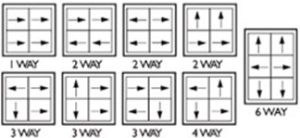
The ceiling outlet is comprised of 4-6 smaller squares called ‘cores’. There are 2 main types of cores – fixed and adjustable.
- An adjustable core allows the user to direct air-flow by turning the blades a particular ‘way’ to direct air-flow in that direction.
- A fixed core only allows for the cores themselves to be rotated to gain direct air flow. To adjust the outlet, simply push up on each of the four segments one at a time and rotate each of them in desired direction for air-flow.
- Ducted disposable filters: Replace every 3-6 months, or up to 9-12 months depending on system usage.
- Ducted reusable filters: Replace every 1-2 years.
- Wall split system filters: These should last the lifetime of the unit if properly maintained with regular cleaning.
Gepps Cross SA Lodge SA
Salisbury Plain, Welland & Lonsdale SA
To test if each zone is fully opening and closing, follow these steps:
- Turn off all zones except one.
- Set the AC unit to fan mode for continuous air-flow.
- Listen for air-flow from the vent in the active zone (e.g., zone 1) to ensure it’s fully open.
- Turn on zone 2 and then turn off zone 1 to verify that zone 1 fully closes and zone 2 opens.
- Repeat this process for all zones, testing one at a time.
- If you can’t hear the air-flow, attach a tissue to the end of a broomstick and hold it near the ceiling vent. The tissue’s movement will indicate whether air is flowing through the vent.
Here’s a quick and easy way to clean your air conditioning vents:
- Plastic vents: Many plastic vents can be cleaned by placing them on the top rack of your dishwasher. Use a gentle, low-temperature setting.
- Hand wash: If you prefer, you can also wash the vents manually using warm, soapy water. Soak and gently scrub them.
- Vacuum: For a quick clean, use the brush-head attachment of a vacuum cleaner to remove dust and debris from the vents.
- Micro-fibre cloth: After vacuuming, gently wipe down the vents with a micro-fibre cloth to remove any remaining dirt or dust.
Be sure to dry vents thoroughly before reinstalling.
- Check the air conditioner’s filters are clean. Air Con Filter Maintenance Ducted, Air Con Filter Maintenance Wall Split.
- Check the indoor air handler (ceiling unit) is free of obstructions.
- Check there aren’t any leaks in the ductwork.
- Is the fan-motor running?
- Is the return air-grille obstructed?
If the system has motorised zone motor control, check they are operating correctly (see our ‘How do I know if all my AC zone motors are operating?’ FAQ).
According to the National Asthma Council (2016), “Higher levels of humidity in the home create an environment for two common asthma and allergy triggers: dust mites and mould” Source: National Asthma Council.

Figure: Approximation of optimal temperature and humidity ranges for individuals with respiratory conditions.
For people with asthma or allergies, managing indoor humidity is crucial. The National Asthma Council suggests that refrigerative air conditioning systems are a better choice for controlling humidity, as they actively reduce moisture levels. Additionally, refrigerative systems help filter out fine dust, pollen, and other airborne particles, providing a cleaner and healthier indoor environment.
- Humidity Impact: Evaporative air conditioners work best on dry, hot days. They are less effective when it’s both hot and humid. Relative humidity significantly affects cooling efficiency. When humidity is at 100%, the air is fully saturated with moisture, making it harder for additional moisture to evaporate. Since evaporative coolers rely on this evaporation process to cool the air, they perform poorly in high humidity. On muggy days, they mainly provide increased air movement rather than significant cooling.
- Humidity Levels: Evaporative coolers are effective when outdoor relative humidity is below 30%. They are reasonably effective between 30-50% humidity. When humidity exceeds 50%, a refrigerative air conditioner is generally more suitable. Relative humidity is determined by comparing the temperatures of two thermometers: one exposed to air (dry bulb) and one with a wet wick (wet bulb).
- Cooling Potential: The effectiveness of evaporative cooling depends on the difference between the dry-bulb and wet-bulb temperatures. At 100% relative humidity, the wet-bulb temperature equals the dry-bulb temperature, limiting the cooling potential. Evaporative systems are most effective with a wet-bulb temperature up to 22°C and can be used in more humid areas up to 24-25°C. However, higher humidity levels will increase discomfort despite the cooling effect.
- Insufficient Ventilation: Evaporative air conditioners need windows and doors to be open to function properly. This allows the hot, humid air to escape outside and helps the system cool the indoor space effectively.
- High Humidity: When the relative humidity is high, the efficiency of an evaporative air conditioner is significantly reduced. The system relies on evaporating water to cool the air, and high humidity makes this process less effective.